Gen-RSI: Recursive Self-Improvement
of Video Generatorsthrough World Proxies

Physics evaluated in a simulator, corrections delivered at the student's own denoising states.

A generated video becomes an executable Blender proxy.
The simulator repairs the proxy.
The render conditions a frozen teacher.
The student learns at its own denoising states.

Gen-RSI overview: a generated video becomes an executable Blender world proxy, a checker diagnoses violations, a verified repair is rendered, and a frozen teacher supervises the student at its own denoising states.
The Gen-RSI loop. A generated video becomes an executable Blender proxy, the simulator repairs it, the render conditions a frozen teacher, and the student is updated at its own denoising states.

Anonymous Authors

Under review · ICLR 2027

Method
Overview
Main Comparison
with Other Methods
Ablation Study
of Loop Rounds
More
Results

Click to jump to each section.


Method Overview

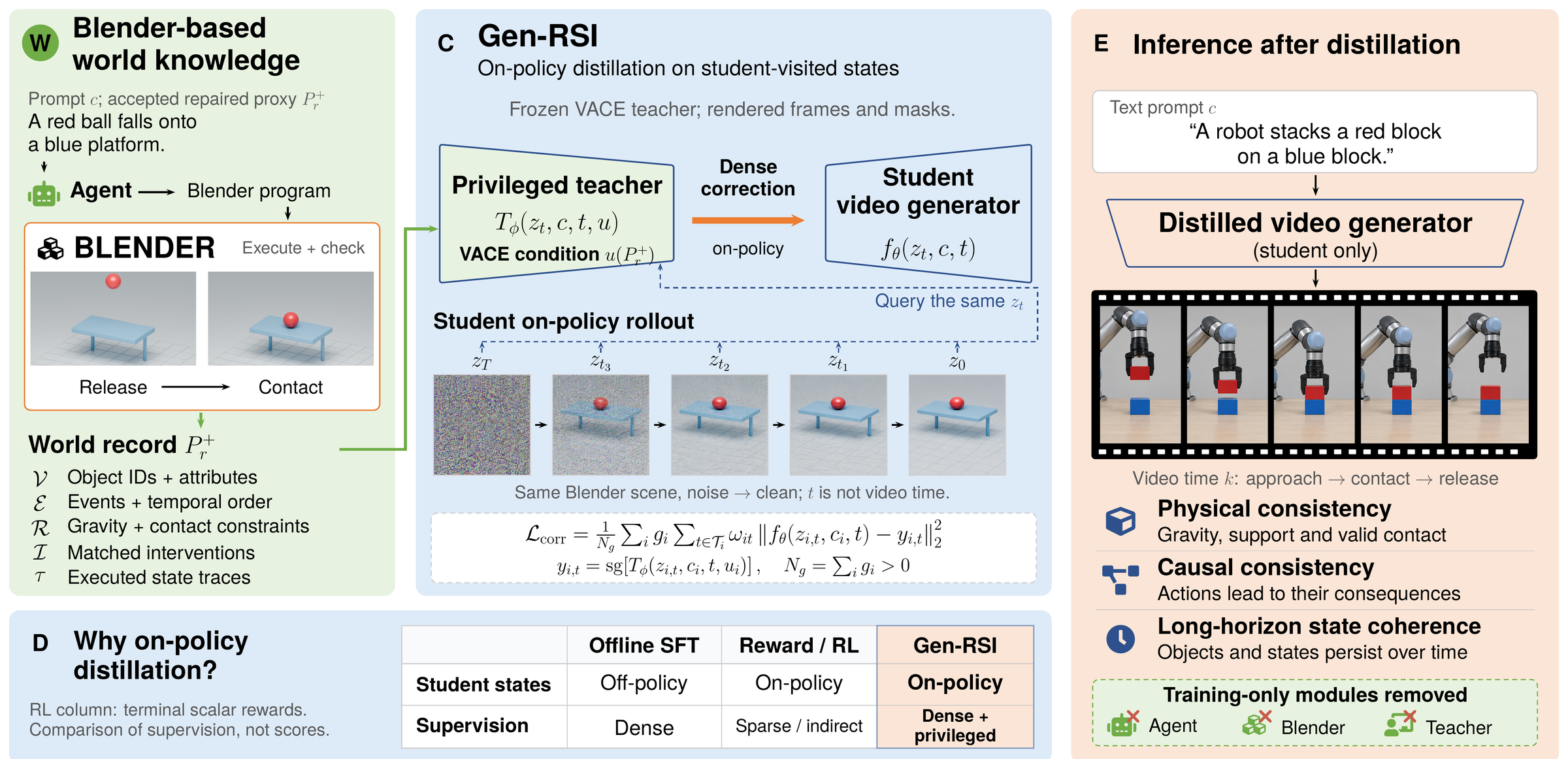
Gen-RSI method: the accepted Blender proxy conditions a frozen VACE teacher whose target corrects the student at its own denoising states.
Figure 1: An accepted Blender proxy renders frames and masks that condition a frozen VACE teacher, and at the same fresh student states the teacher's detached target corrects only the student. At inference only text and the student remain.

Main Comparison with Other Methods

Figure 2: Qualitative comparison with other methods, one text prompt per row.

Ablation Study of Loop Rounds

Figure 3: Qualitative ablation of loop rounds, the same case after 0, 1 and 2 repair rounds.

More Results

Figure 4: More results across physical phenomena.

BibTeX

@inproceedings{genrsi2027,
  title     = {Gen-RSI: Recursive Self-Improvement of Video Generators through World Proxies},
  author    = {Anonymous Authors},
  booktitle = {International Conference on Learning Representations (ICLR)},
  year      = {2027},
  note      = {Under review}
}